

If you've tried getting Claude to automate part of your work, got it working, and then quietly stopped using it, you're in very good company.
I run a growth engineering studio that builds these systems for companies every day. More than half of the founders who come to us for help have already tried building one themselves. They know how to use Claude. They built something. It ended up giving them more work than they started with.
If you watched my Reel, this is the longer version with the parts I couldn't fit into three minutes. We'll cover why the first week is misleading, the job you take on without noticing, when it makes sense to hand it over, and three things I'd do if you're building your own.
If you're new here, 5 steps to having AI run growth systems for you covers the order I'd build in, What is growth engineering? covers what you're building, and Testing Jev covers where AI growth systems are heading. This one is about what happens after you've built one.
1. The two ways it ends
When founders tell me about the system they built, it has usually ended one of two ways.
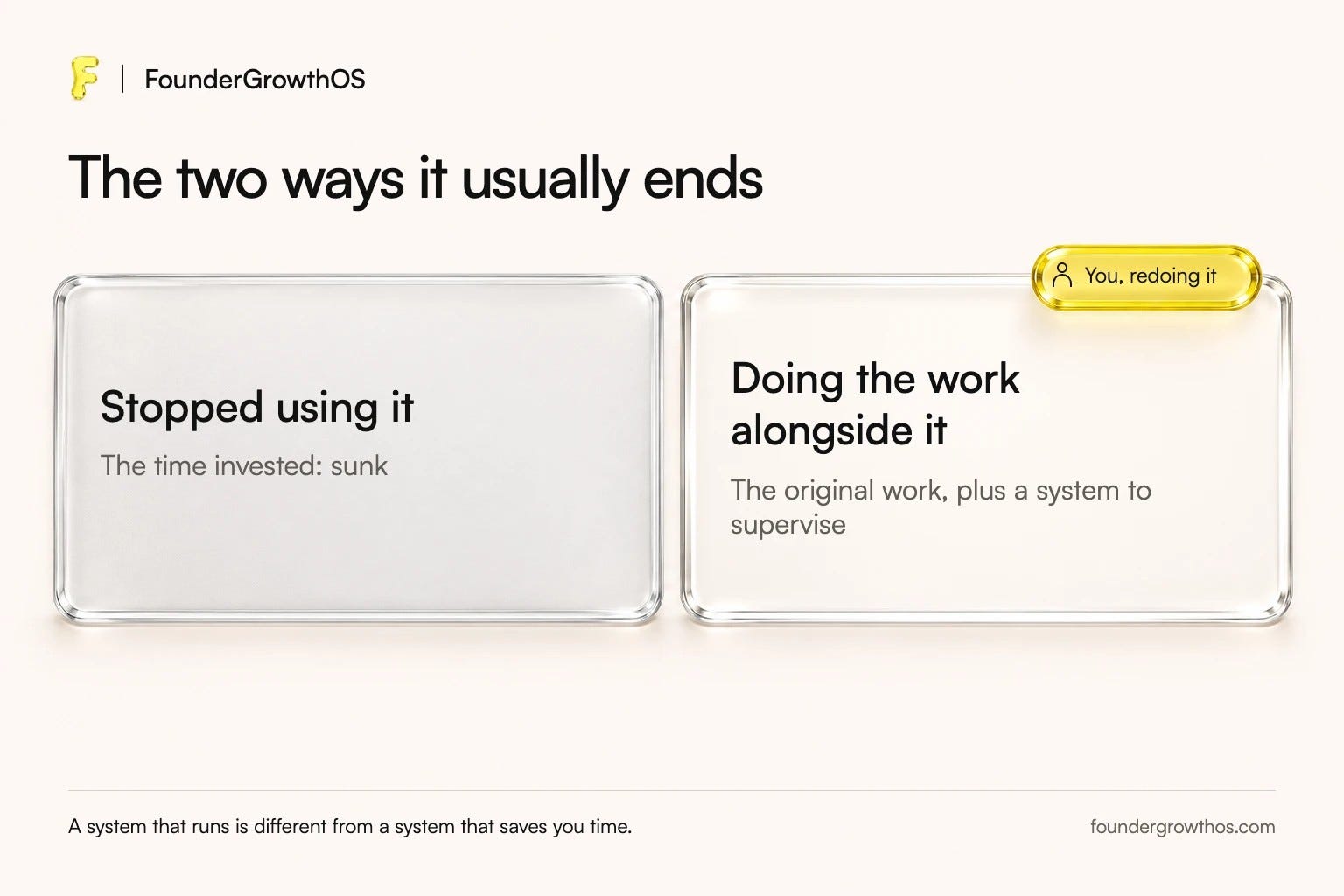
They stopped using it. It worked for a while, then it got something embarrassing wrong, or it needed fixing one too many times, and it slowly stopped being opened. All the time that went into it is sunk.
They're doing the work alongside it. It still runs. They just don't trust what it produces, so they check everything, redo half of it, and now they have the original work plus a system to supervise.
The second one is sneakier, because it looks like progress. Something is running. It just isn't taking anything off anyone's plate.
It happens well beyond founders, too. MIT's NANDA initiative looked at company AI pilots last year and found about 5% achieved rapid revenue acceleration. The rest stalled, with little or no measurable impact on profit and loss. That's enterprise pilots rather than a founder with a Claude project, so I wouldn't stretch the number further than that. The shape is familiar though.
Leave this section with: a system that runs is different from a system that saves you time. Only the second one counts.
2. Why the first week is misleading
It almost always starts well.
It's simple enough now to say to an AI: here's our ideal customer, go and find 250 candidates and draft outreach for me. It's easy to connect it to your inbox and have it read your messages. You get something working, you see good results, and understandably you think: great, that's sorted.
The first week tests the easy cases. Your real business is mostly the other ones.
Making it work consistently means making it work with your actual business information, which is scattered, partly out of date and occasionally contradicts itself. It means the exceptions: the client who does it differently, the prospect who's also an investor, the reply that's technically a yes but really a not-now, the week your offer changed.
None of those show up in the demo. All of them show up by week three.
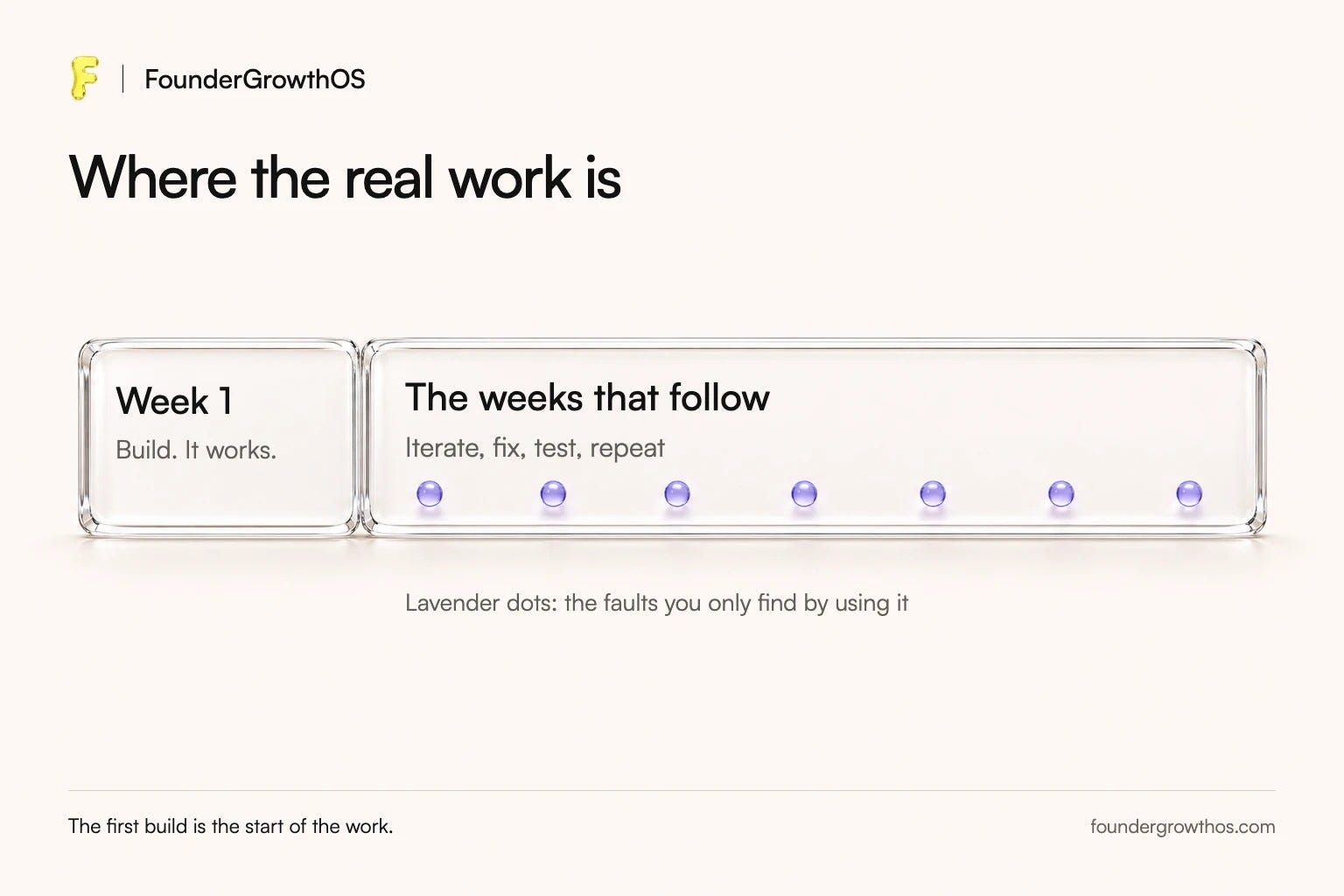
Leave this section with: the first build is the start of the work. The real work is in the weeks that follow.
3. The job you didn't apply for
The more you use it, the more faults you see. And suddenly you're wearing a builder hat instead of a marketing hat.
Here's what that week looks like:
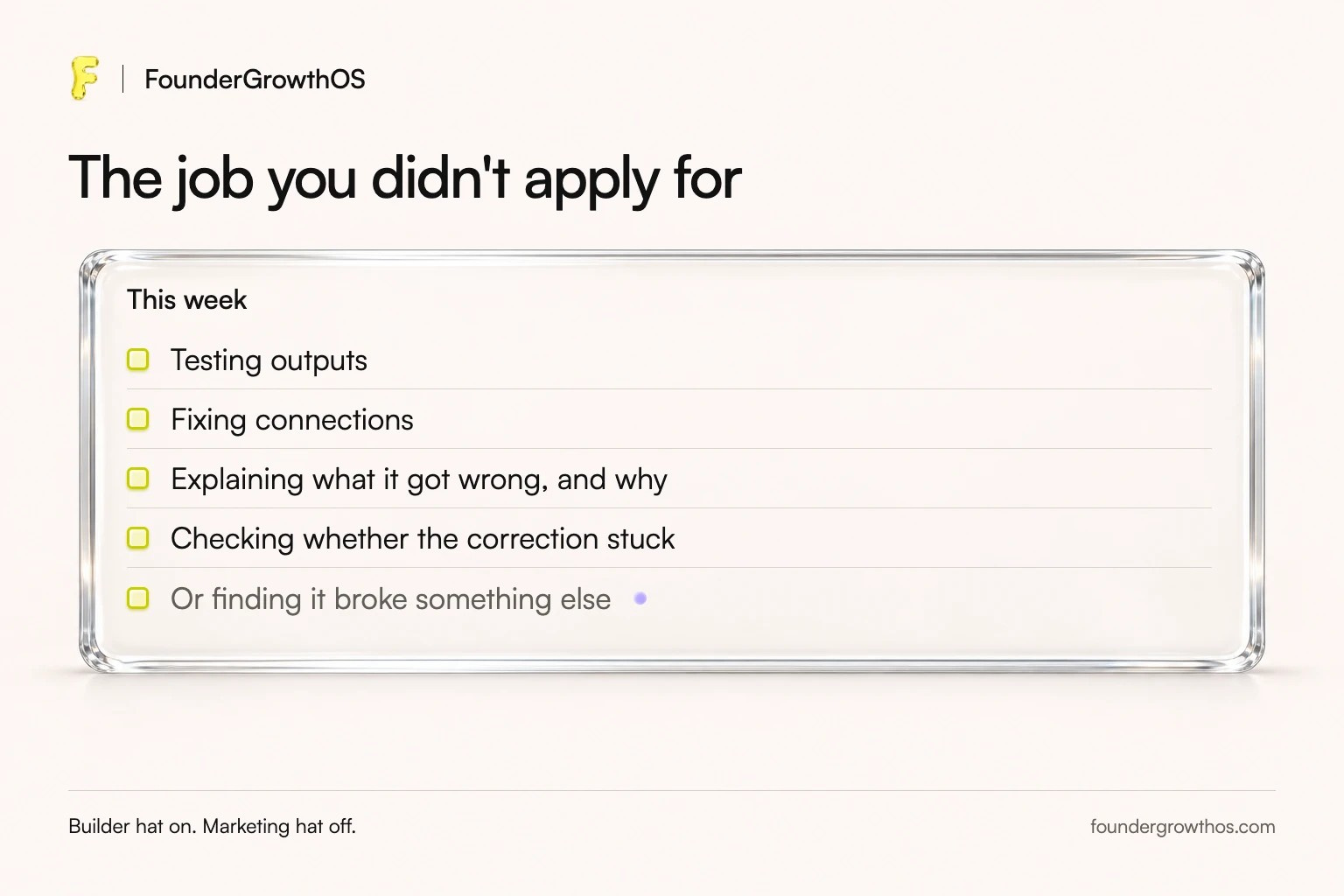
Testing outputs. Reading what it produced and deciding whether it's right.
Fixing connections. The inbox disconnected, the spreadsheet changed columns, a tool updated.
Explaining what it got wrong, and why. Which takes longer than doing the task yourself, the first few times.
Checking whether the correction stuck. Or whether it broke something somewhere else.
Before you know it, you've spent three weeks doing an entirely new job: maintaining the machinery. Meanwhile the work you actually wanted it to handle is still sitting there waiting for you, and everything else on your to-do list gets pushed back. Or you stop using what you built, which is ending number one.
None of this means you did it wrong. This is simply what running a system involves. The trouble is that nobody budgets for it, because the tutorial ended at "and now it's working".
Leave this section with: building a system gives you a second job. Decide in advance whether you want it.
4. The bread problem
AI is definitely making it easier to do things ourselves. But it's a bit like baking your own bread.
You absolutely could. You could also go to a good sourdough bakery, and it would be quicker, probably cheaper in the long run once you count your time, and better.
Having the ability to learn something doesn't mean you have the time to learn it well.
Almost none of our clients come to us because they can't build the thing. They come because they don't have the time to do it properly. MIT's report points the same way: buying from specialised vendors and partnering succeeded about 67% of the time, and internal builds about a third as often. Again, that's companies rather than founders. I'd still take it seriously.
Plenty of founders should build their own, and enjoy it. Just decide with the whole cost in view.
Leave this section with: the question is whether you have the time to build it and keep it good, alongside your actual job.
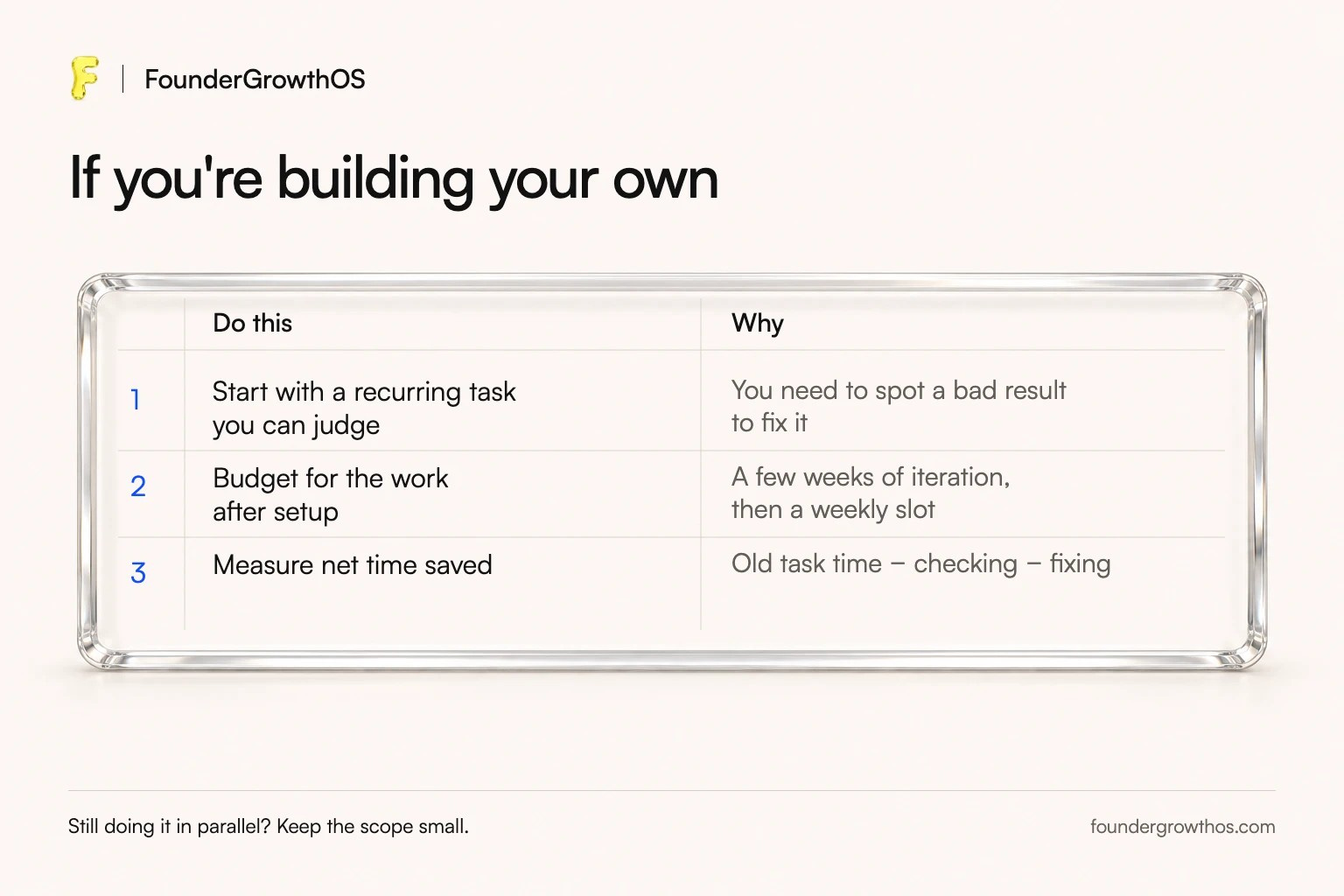
5. If you're building your own, do these three things
One: start with a recurring task you can judge
Pick something that happens often and that you understand well. You need to be able to recognise a bad result quickly, or you can't teach the system what to improve.
"Run my growth" is too big. "Each weekday, prepare up to five prospects for my review, with the evidence for each" is about right.
Before you build, time yourself doing it by hand a few times. You'll need that number later.
Two: budget for the work after setup
This is where most people get it wrong.
Give yourself a few weeks of iteration before you expect the output to be great. A very simple automation needs less. Something that runs a whole part of your business needs more.
Then protect it. Give yourself a dedicated slot, say an hour a week, to do three things in order:
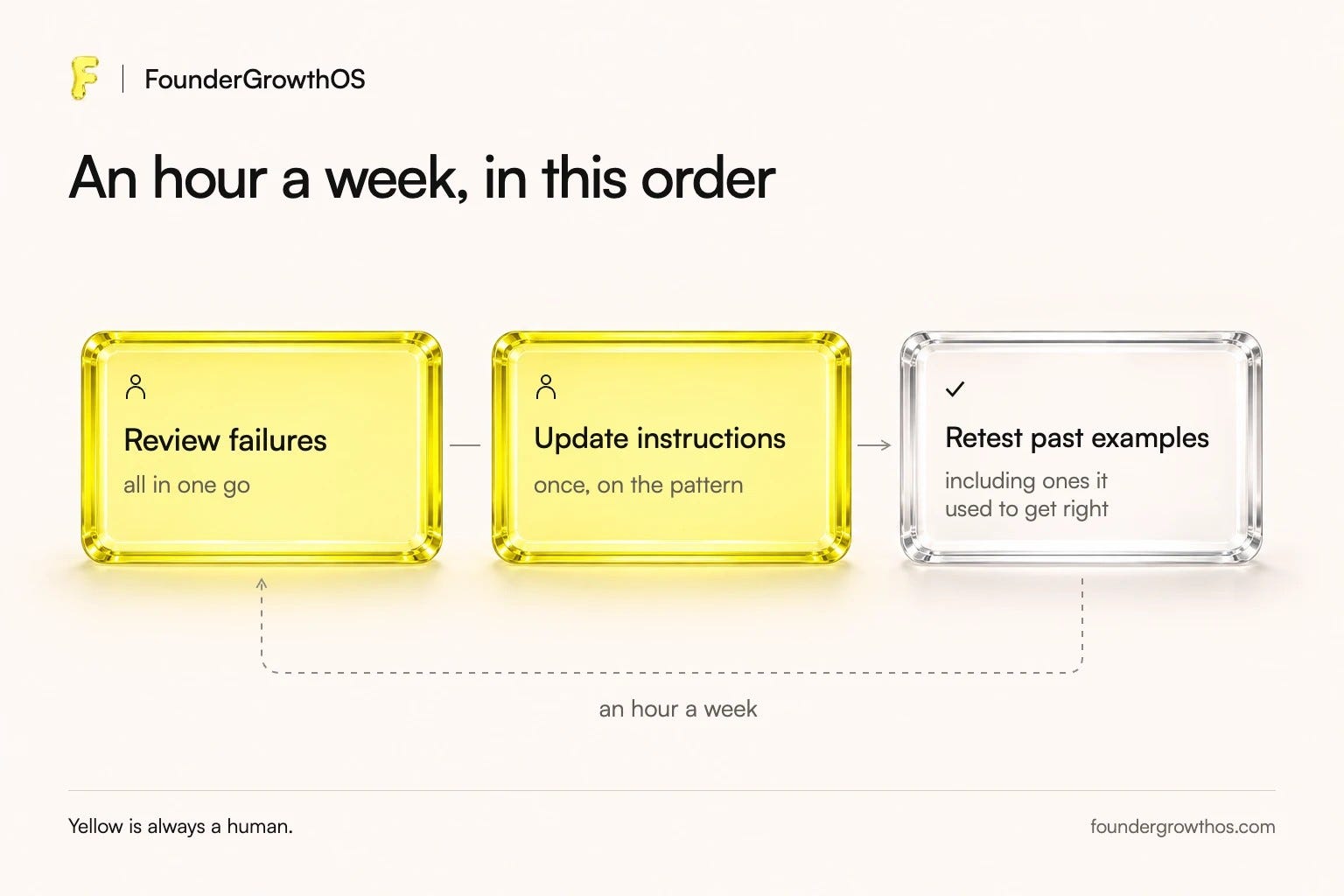
Review the failures from that week, all in one go.
Update the instructions once, based on the pattern, rather than the loudest example.
Test the new version against a handful of past examples, including ones it used to get right.
That last step is the one people skip, and it's the reason corrections quietly break other things. Keep five or ten saved examples with the answer you expect. Run them every time you change something.
You'll see results get systematically better, rather than drifting every time you give it feedback because something annoyed you on a Tuesday.
A simple log helps more than you'd expect. Five columns: the date, what it did, what should have happened, what you changed, and whether you retested.
Three: measure whether it's taking work off your plate
This is the most important one.
Count the time you spend checking and fixing it, not just the time it saves. The number I'd actually care about:
Net time saved = time the task used to take − time spent checking − time spent fixing
Suppose a task took you an hour and now takes 15 minutes of checking plus 10 minutes of fixes. That's 35 minutes saved, before you count setup. Those are illustrative numbers. Measure your own.
If you're still doing everything in parallel, or your real work is getting delayed, keep the scope small. Get one part to the point where you trust it, then build on top of it.
Leave this section with: one task you can judge, a protected weekly slot, and a number that tells you whether it's working.
What I'd do first this week
Look at the system you've already built, if you have one. Be honest about which ending it's heading for.
If it's running but you're redoing its work, don't add features. Pick the three failures that cost you the most time last week, write down what should have happened, and fix those in one sitting. Then save them as test examples so they stay fixed.
If you haven't built anything yet, time yourself doing the task by hand this week. That number decides whether building is worth it.
You can absolutely learn to do this. Just go into it knowing you're learning to build and maintain a system, and give yourself the time for that.
And if you need the work handled but don't have room for the building part, that's exactly what founders come to us for at FounderGrowthOS.
If you'd like help, reply with the system you built (or want to build) and which of the two endings it's heading for. That's a much better place to start than "can you make it work?"